




For 40 years, this facility has carried out highly demanding machining work for the aerospace, defense, medical, and transportation industries. In recent years, the company began growing and needed to scale up production.
The number of multi-spindle screw machines increased from three to eight. As a result, the existing chip- and coolant-handling system could no longer keep up with the higher workload.
The end result was lower operating costs, less waste, and full process automation.
The Challenge
The client is an international company specializing in precision machining. Its main site handles key production processes, including milling, grinding, turning, and laser powder-bed fusion. The facility also houses prototyping departments as well as precision measurement and quality control (metrology).
The main problems included:
- Outdated equipment. The main plant, commissioned in 1998, operated with an inefficient, undersized automatic chip-handling system.
- A labor- and time-intensive process. The previous setup required a large amount of manual work and constant operator attention.
- Rapid production growth. In 2005, the number of multi-spindle screw machines increased from three to eight, and the existing system was no longer able to handle the new scale of production.
- Insufficient fluid recovery. The original process did not recover enough fluid from the chips, forcing the plant to regularly order fresh oil to make up the losses.
The client needed a solution that could keep pace with production, operate automatically, and meet the company’s high operational standards.
The Solution
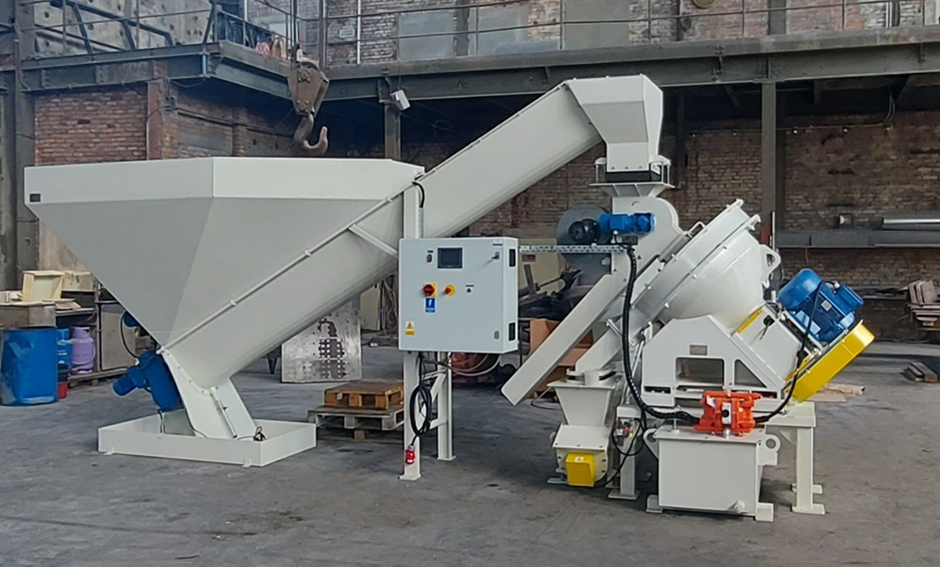
We designed a custom-tailored process line that today handles an average of around 15 m³ of various steel alloys per day. The material comes from eight multi-spindle screw machines and Swiss-type CNC lathes.
Key stages of the process:
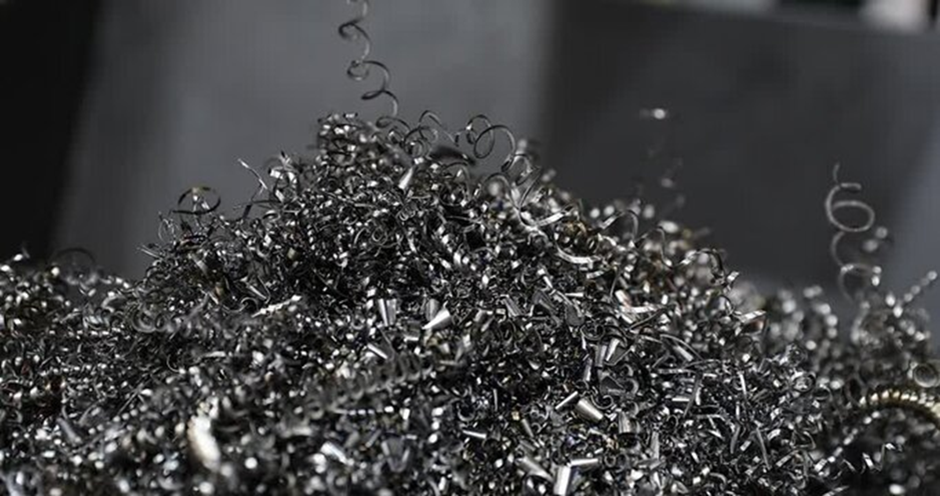
- Chip loading. Operators use forklifts to load chip containers into a vertical-axis crusher. The device reduces tangled chips into smaller fragments that can be easily conveyed further.
- Contaminant removal. The material then passes through a tramp-metal separator, which removes items such as broken tool fragments or rod ends.
- Automatic conveying. The cleaned chips are automatically conveyed by a steel belt conveyor to the centrifuge.
- Oil recovery. The centrifuge separates oil and coolant from the metal chips. The recovered fluid goes into a dedicated tank, where it is filtered and reused in the machines.
- Dry material discharge. At the end of the process, the dewatered chips are discharged into a roll-off container with a capacity of around 1.1 m³, ready for pickup or recycling.
The entire line operates fully automatically, with minimal operator involvement — one of the client’s key requirements.
Implementation Results
The new system delivered results good enough that the company decided to implement a similar solution at a second facility.
- A sixfold reduction in metal-waste volume, meaning less space taken up and a significant reduction in transport and handling costs.
- Near-total recovery of cutting oil. Around 1,135 liters of oil that previously left the plant with the chips are now returned to production every day.
- Lower operating costs. Despite running more machines, the company now uses less oil than it did when only three lathes were in operation.
- Full process automation. The entire system runs automatically, simplifying operations and reducing the need for manual handling.
Do you have similar challenges at your production facility? Get in touch with us. We’ll help you find a solution tailored to the specifics of your business.