




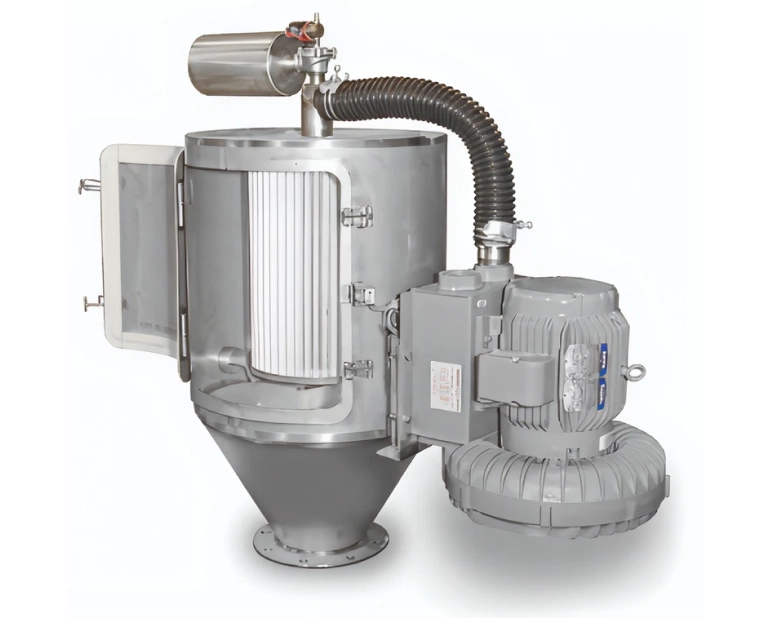
Where vacuum demand and conveying distances are moderate, elaborate pressure systems can be unnecessary. Discover vacuum conveyors with a built-in regenerative blower. Find out when they’re the right fit and what benefits they bring.
Pneumatic conveying systems are often an excellent choice for moving large quantities of powdered, granulated, or pelletized materials. Among the many approaches to pneumatic conveying, vacuum systems powered by a regenerative blower offer optimal cost-effectiveness, compactness, and simplicity where vacuum requirements and conveying distances are moderate.
Other system types, such as pressure-conveying solutions, are designed to move heavier materials over longer distances; they require high pressure, large capital investment, greater energy consumption, and higher maintenance costs. Scaling that pressure technology down for smaller volumes over shorter distances isn’t always practical or economical. This is where regenerative-blower vacuum systems excel: they offer the right combination of design and operating characteristics, translating into excellent economics for lighter-duty applications.
How It Works
Vacuum conveyors are relatively simple setups made up of a pickup inlet, a conveying line, a receiver, and a vacuum generator, which serves as the power source. The generator creates the vacuum needed to draw material through the line into the receiver. Internal filters separate the material from the air, removing dust and protecting the generator.
Various valve arrangements are used to discharge product from the receiver: simple slide gate valves, pneumatic dump valves, or rotary airlock valves.
The vacuum source can be a regenerative blower, a compressed-air-powered ejector (Venturi), a central vacuum system with liquid-ring pumps, a low-pressure blower, or a positive-displacement vacuum pump. Aside from regenerative blowers, all of these sources sit external to the conveying unit.
Vacuum systems are preferred for materials prone to clumping or clogging in pressure systems. They also work well where space is limited. For many lightweight materials, conveying speed can be high. A key limitation is range: they’re generally not used for conveying distances beyond about 60 m (200 ft), or lift heights above about 15 m (50 ft).
Integrated Vacuum Generator
Unlike almost all other pneumatic conveying technologies, regenerative-blower systems are unique: the vacuum generator is an integral part of the unit, so no external air or vacuum source is needed.
Regenerative blowers are very simple and reliable. They consist of just a few components: an electric motor with sealed bearings, an impeller, and a housing with a cover. They have no other moving or wearing parts requiring lubrication or maintenance.
How a Regenerative Blower Works
Regenerative blowers operate on the principle of vortex airflow. As the single-stage impeller rotates inside the housing, air is moved between the blades. The spinning impeller and airflow create a vortex that progressively increases the air’s velocity as it moves from blade to blade. On the outlet side, the flow is very stable and smooth.
Advantages of Self-Contained Regenerative-Blower Systems
- Lower upfront costs: the systems are self-contained and require only an electrical power connection.
- Lower operating costs: compared with externally powered systems, units with an onboard regenerative blower offer significantly higher energy efficiency.
- No competition for plant air or vacuum with other equipment.
- Easy installation: these systems weigh less and take up less space than other pneumatic solutions.
- Easy cleaning: designed with tool-free access to filter cartridges for routine filter cleaning.
- Oil-free air.
- Low noise levels.
Comparison With Other Technologies
For similar applications, two alternatives to regenerative systems are sometimes used: positive-displacement technology and compressed-air blowers. They differ mainly in capital cost, energy efficiency, and service requirements — areas where the regenerative solution generally comes out ahead for lighter-duty applications.
Implementation Examples
Automating material handling improves safety, economics, and production efficiency. Werner G. Smith, an Ohio-based chemical manufacturer, secured a long-term contract to blend granulated powder with an aqueous chemical solution. The company had a large reactor it could dedicate to the process, but the building housing it created major logistical problems.
Hapman designed a material conveying system including a bag dump station with loss-in-weight dosing, feeding a vacuum conveying system that delivered material to the process. The system includes an integrated regenerative blower, integral filtration, a reverse-pulse filter cleaning mechanism, and automatic batch controls.
The results were nearly immediate. Production time was reduced by several hours per batch, and plant cleanliness improved significantly. The system also eliminated the need for an outside vendor to repackage material into 25-kilogram bags, and five employees were reassigned to tasks directly tied to production.
A vacuum conveying system eliminates cross-contamination at a pharmaceutical company.
A large pharmaceutical manufacturer needed a vacuum conveyor system to collect finished product from a dryer and transfer it to a mobile bulk-material handling system mounted on a scale for precise dosing and portioning. The challenge was implementing efficient cleaning that eliminated the risk of cross-contamination during product changeovers.
Hapman designed a vacuum pneumatic conveying system with individually controlled spray nozzles positioned inside the conveyor. This self-contained design made it possible to reliably clean and disinfect the interior without time-consuming external procedures. Additional improvements included side access doors for quick filter-cartridge changes and a rotary valve for clean-in-place (CIP), enabling disassembly, cleaning, and reassembly within minutes. The entire unit was built from 304 stainless steel, with sealed motors and controls rated for explosive atmospheres and washdown. The system met all design targets, increasing throughput and processing speed.
Summary: The Ideal Choice for Moderate Requirements
Regenerative-blower vacuum conveying systems aren’t suited to every application: they won’t replace the more powerful setups needed to move heavier materials over longer distances. But for smaller, shorter installations operating at lower vacuum or air-consumption levels, they offer a distinctive set of advantages.
Their efficiency, ease of operation, small footprint, and low service requirements offer a unique combination of economy and practicality.
Advantages of Pneumatic Conveying
- Simple construction — essentially a tube, a receiver, and a vacuum source,
- Fully enclosed — no dust, contamination, or ignition sparks,
- No large, heavy conveyors with numerous wear parts,
- Good to excellent energy efficiency,
- Operates horizontally and vertically,
- Quiet operation.